Individual Report: B41357 Roderick MCLEOD
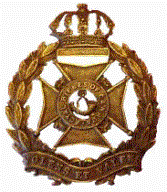
1st Bn The Royal Rifles of Canada

General Information |
||
| Rank: | First Name: | Second Name: |
|---|---|---|
| Rifleman | Roderick | Morrison |
| From: | Enlistment Region: | Date of Birth (y-m-d): |
| Powell River BC | Central Ontario | 1900-08-03 |
| Appointment: | Company: | Platoon: |
| D | 18R Plt | |
Transportation - Home Base to Hong Kong
Members of 'C' Force from the East travelled across Canada by CNR troop train, picking up reinforcements enroute. Stops included Valcartier, Montreal, Ottawa, Armstrong ON, Capreol ON, Winnipeg, Melville SK, Saskatoon, Edmonton, Jasper, and Vancouver, arriving in Vancouver on Oct 27 at 0800 hrs.
The Winnipeg Grenadiers and the local soldiers that were with Brigade Headquarters from Winnipeg to BC travelled on a CPR train to Vancouver.
All members embarked from Vancouver on the ships AWATEA and PRINCE ROBERT. AWATEA was a New Zealand Liner and the PRINCE ROBERT was a converted cruiser. "C" Company of the Rifles was assigned to the PRINCE ROBERT, everyone else boarded the AWATEA. The ships sailed from Vancouver on Oct 27th and arrived in Hong Kong on November 16th, having made brief stops enroute at Honolulu and Manila.
Equipment earmarked for 'C' Force use was loaded on the ship DON JOSE, but would never reach Hong Kong as it was rerouted to Manila when hostilities commenced.
On arrival, all troops were quartered at Nanking Barracks, Sham Shui Po Camp, in Kowloon.
Battle Information
We do not have specific battle information for this soldier in our online database. For a detailed description of the battle from a Canadian perspective, visit Canadian Participation in the Defense of Hong Kong (published by the Historical Section, Canadian Military Headquarters).
Wounded Information
No wounds recorded.Hospital Information
No record of hospital visits found.POW Camps
| Camp ID | Camp Name | Location | Company | Type of Work | Arrival Date | Departure Date |
|---|---|---|---|---|---|---|
| HK-SM-01 | Stanley | Fort Stanley, Hong Kong Island | Capture | 41 Dec 30 | ||
| HK-NP-01 | North Point | North Point, Hong Kong Island | 41 Dec 30 | 42 Sep 26 | ||
| HK-SA-02 | Shamshuipo | Kowloon, Hong Kong | 42 Sep 26 | 43 Aug 15 | ||
| JP-To-5B | Niigata-Rinko | Niigata-ken, Nakakambara-gun, Ogata-mura, Japan | Marutsu, Rinko Coal, Shintetsu | Stevedore labor at port of Niigata (Marutsu), primarily foodstuffs; mining coal (Rinko Coal ) and labor at a foundry (Shintetsu) | 43 Sep 03 | 44 Mar 03 |
Transport to Japan
| Draft Number | Name of Ship | Departure Date | Arrival Date | Arrival Port | Comments | Reference |
|---|---|---|---|---|---|---|
| XD4B | Manryu Maru | 43 Aug 15 | 43 Sep 01 | Osaka, Japan | Brief stopover in Taihoku (Taipei), Formosa (Taiwan); then 2 day stopover at northern point for stool tests | Tony Banham |
Other Military or Public Service
He served with the 38th Dufferin Rifles, then with the 215th Battalion, CEF, service number 270445, from 15 June 1916 to 11 April 1917 because he was too young for overseas service, and with the 2nd Battalion, 1st Central Ontario Regiment, service number 3310783, from 20 January 1918 until he was demobilized on 17 June 1919.
Death and Cemetery Information
| Date of Death (y-m-d) | Cause of Death | Death Class | |
|---|---|---|---|
| 1944-03-03 | Amoebic Dysentry, Beri Beri, Chronic Enteritis | Died while POW | |
| Cemetery Location | Cemetery | Grave Number | Gravestone Marker |
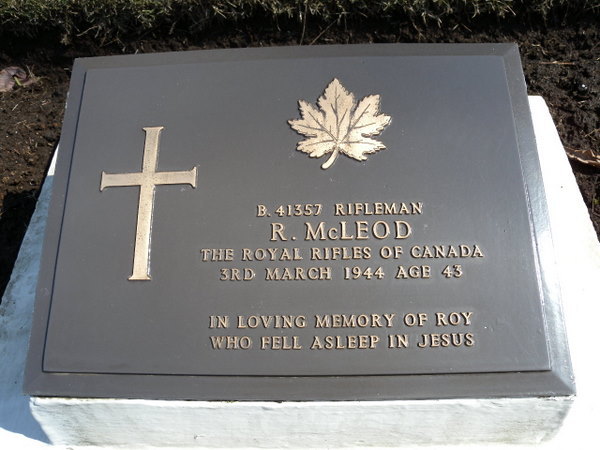
| Jido-Yuenchi-Dori Hodogaya Japan | Yokohama War Cemetery | Cdn. Sec. B. C. 4. | CWGC |
Gravestone Image
Obituary / Life Story
Rfn. Roderick McLeod, whose sister is Mrs. Mary Baker, Box 177, Powell River. Taken a prisoner at Hongkong, Christmas, 1941. Rfn. McLeod died on March 3 in a Japanese prison camp at Tokyo as a result of beri-beri.
Born and educated at Brantford, Ont., Rfn. McLeod enlisted in 1939 with the Lincoln and Welland Regiment and transferred to the Royal Rifles of Canada before going to the Far East.
Last word from him was received by his sister last August, which she reports was not his handwriting. The letter said he was "well taken care of."
Unknown newspaper clipping
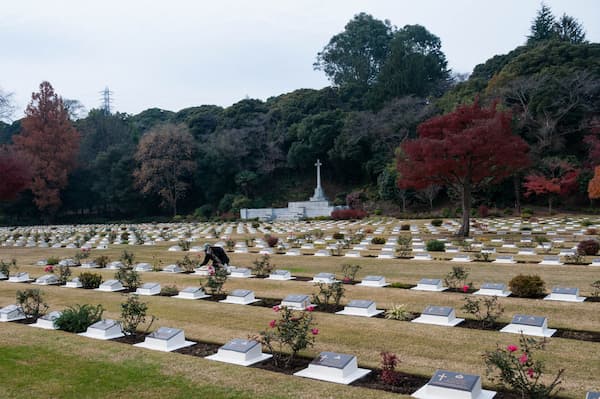
136 members of 'C' Force are buried in the Yokohama War Cemetery which was constructed by the Australian War Graves Group after the Second World War. It contains the graves of Commonwealth servicemen who died in Japan as prisoners of war or with the occupying forces after the war. It comprises of four main parts: the United Kingdom section, the Australian section, the Canadian and New Zealand section and the Indian Forces 1939-1945 section. The cemetery contains 1,555 Commonwealth burials and commemorations of the Second World War, including 53 unidentified burials and a small number of special memorials to casualties known to be buried in the cemetery, whose graves could not be precisely located.
Ref: Includes excerpts from Veterans Affairs Canada.
General Comments
B41357 Roderick MCLEOD- Died March 3, 1944 in at the age of 43 in Niigata, Japan
Born in Glasgow, Scotland. Enlistment:July 22, 1940 Niagara Camp, Ontario
Son of John and Millicent McLeod.
Residence Place: Powell River, Vancouver, B.C.
Next of Kin: Mary Baker. Relationship: Sister
BLACKIE- How many of us remember Blackie McLeod? Blackie was a member of "D" Company, and as I recall, he was a bit of a lone wolf; but what I remember most about Blackie is the way he used to provide lights for our cigarettes, those of us who had them in the prison camp.
Blackie had a "punk box", a small round can like the ones that ointment comes in. In the can he had a scrap of cotton which he had burned to a char. To get a light, he would open the can, and with a piece of steel, say an old table knife, and with a piece of stone, he would strike the knife until a spark became lodged in the "punk". When the punk started to glow, he would blow on it until there was a coal big enough to light a cigarette. When he put the cover back on the can, the fire went out and his punk box was ready for the next time.
Needless to say, Blackie's services were often in demand, because matches didn't exist.
Not only were cigarettes hard to come by, but after a while matches also were not available. Blackie McLeod solved the problem. Blackie got a small, flat can with a tight cover, one such as ointment used to come in. In it he put a swatch of cotton, and burned it until it was charred. Then he clapped the cover on it to extinguish the fire. He called it a "punk box". Then, when he wanted a light for his fag, he would open the punk box, and strike a piece of steel with a piece of stone over it until a spark appeared in the charred cotton.
Then he would blow on the spark until it glowed red. Then it was ready to give a light to a cigarette. Then the cover was replaced, and the punk box was ready for the next time someone wanted a light.
Blackie was very patient with everyone, never refusing to perform. He was a quiet fellow. I don't remember ever hearing him say much. He obviously had been around and had seen much of life before entering the army. In the Royal Rifles, he was one of a kind.
Links and Other Resources
There may be more information on this individual available elsewhere on our web sites - please use the search tool found in the upper right corner of this page to view sources.
Related documentation
Our HKVCA Vault (Google Docs) may contain additional information, newspaper clippings, and documents which have been saved for this soldier. To access this information, note the soldier's service number shown at the top of this page, then use the letter prefix to select the corresponding link below. A Google Docs folder list will open in a separate tab. Search for the file identified by the service number to access any additional information we may have acquired.
- Service Number Prefix: A to G
- Service Number Prefix: H to P
- Service Number Prefix: X (Officers)
Facebook has proven to be a valuable resource in the documentation of 'C' Force members. The following link will take you to search results for this soldier based on his regimental number, but they may be incomplete.
Facebook Search Results.
To capture all items for an individual, we recommend visiting our Group: Hong Kong Veterans Tribute of Canada and using the search option there. Note: results may be contained within another related record.
Find a Grave® is a valuable resource that may contain additional information on this 'C' Force member. When you arrive at the site search page, fill in as much detail as you can for best results.
End of Report.
Report generated: 04 Apr 2026.
Additional Notes
(These will not be visible on the printed copy)
- Service numbers for officers ("X") are locally generated for reporting only. During World War II officers were not allocated service numbers until 1945.
- 'C' Force soldiers who died overseas are memorialized in the Books of Remembrance and the Canadian Virtual War Memorial, both sponsored by Veterans Affairs Canada. Please use the search utility at VAC to assist you.
- Some birthdates and deathdates display as follows: 1918-00-00. In general, this indicates that we know the year but not the month or day.
- Our POW camp links along with our References link (near the bottom of the 'C' Force home page) are designed to give you a starting point for your research. There were many camps with many name changes. The best resource for all POW camps in Japan is the Roger Mansell Center for Research site.
- In most cases the rank displayed was the rank held before hostilities. Some veterans were promoted at some point prior to eventual post-war release from the army back in Canada. When notified of these changes we'll update the individual's record.
- Images displayed on the web page are small, but in many cases the actual image is larger. Hover over any image and you will see a popup if a larger version is available. You can also right-click on some images and select the option to view the image separately. Not all images have larger versions. Contact us to confirm whether a large copy of an image in which you are interested exists.
- The 'From' information box at the top of the report represents the enlistment location unless we have obtained updated information pinpointing where the member lived.
- In some cases the References displayed as part of this report generate questions because there is no indication of their meaning. They were inherited with the original database, and currently we do not know what the source is. We hope to solve this problem in future.
- We have done our best to avoid errors and omissions, but if you find any issues with this report, either in accuracy, completeness or layout, please contact us using the link at the top of this page.
- Photos are welcome! If a photo exists for a 'C' Force member that we have not included, or if you have a higher quality copy, please let us know by using the Contact Us link at the top of this page. We will then reply, providing instructions on submitting it.